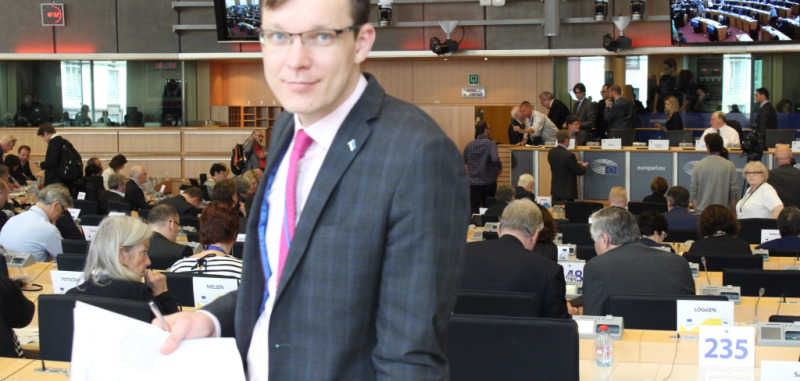
A new digital political arena has emerged, where technologies can help us finding new solutions, improving public services and increasing the participation of citizens in new ways to improve local democracy. We talk to Rait Pihelgas (EE/Reform Party) whose report “Strengthening local governance and representative democracy via new digital technology instruments” will be approved by the European Committee of the Regions.
“Representative democracy is not about voting after a certain period but about continuous interaction between the citizens and local representatives. My report therefore addresses the importance of engagement and participatory practices” Pihelgas says by way of introduction to the topic.
COVID-19 obviously had a big impact on his report. “It presented us with the biggest challenges of recent times, and we ought to use this opportunity to learn. The recommendations in the report have not been influenced directly by the current pandemic but their intention is hopefully more significant now”.
How does he think that COVID-19 will change local democracy?
It is what we take from the pandemic. We were forced to abandon many ways in our daily routine, the question is whether some of them are worth bringing back after we “resume to normal”. We should not waste this crisis but make improvements. How do we decide at the local level, do we need to gather physically, or can the modern ICT be of use? How do we take care of the most vulnerable? How can we keep our education system open and what are the tools to be used for it? Where do we lack knowledge, where do we lack equipment? These are all questions we need to ask and address and this will all impact decision making at the local level and ultimately democracy
Democracy and the Rule of Law in Europe are important debates right now in Europe. Pihelgas believes technology can be a part of the solution:
Clearly, the technology can be of use, but it would be naive to suggest that an application or a platform will solve everything. I therefore believe that it is a more fundamental issue: it’s the way we practice politics, the way we communicate, the way we engage
Digital Democracy a risk for the local level?
Extremist parties are in power at different levels of government, including in Estonia. New technologies have also given visibility to these extremist views. Does digital democracy therefore present a risk for social cohesion at the local level ?
Again, it is not the technology but the people and mindsets. We have to acknowledge that extremists or populist forces do not spring up from nothing. The first thing we need to do is to ask ourselves whether the policies and alternatives we are offering are sufficient for the current needs. Or is there something we are missing? In other words, we should not just lament about the spread of populists’ views but put forward an alternative. The recent election in the U.S. provided us with an example
That’s where Pihelgas advice to Mayors kicks in if they want to modernize the democratic system of their municipalities:
First and foremost, the change starts with oneself. It is not enough to implement modern tools, but you need to have the right mindset and willingness to do it. One has to be genuine about it and committed. Ultimately, remember that the use of modern ICT and engagement is time consuming but if the outcome is a more coherent society or a transparent local government, it is worth investing it
And the EU can contribute to the development of local and regional authorities’ development in this digital age and with new technologies: “In my report I have recommended to support SAAS (service as a service) concept. I think the EU should look at such practices and support (financially) if possible. The idea is to boost social innovation and new solutions, and this is something the EU stands for”.